From Colombia's ghost to Klopp's tears: the best World Cup ads of match week one
Issue 4 covers eight standout campaigns from the tournament's opening week: Buchanan's national-healing Colombia epic, Budweiser's Haaland/Klopp pairing, Uber Eats' Gordon Ramsay global launch, Visa's Ted Lasso tap-in play, Coors Light's Andrés Cantor sonic brand hack, Brahma's Brazilian doubt-reframe, Powerade's next-gen casting, and Levi's stadium-wrap ambush. Plus three cross-campaign trend observations on celebrity scarcity, emotional specificity, and the non-sponsor creativity lead.

The first whistle blew on June 11. Within 48 hours, a second, quieter wave of World Cup advertising broke — match-day campaigns built not to earn pre-tournament PR but to ride the emotional momentum of actual football being played. This week's eight standouts show how different that second gear looks: rawer emotions, craftier sonic hooks, sharper cultural angles, and at least one genuine ambush that may be the cleverest brand move of the entire tournament.
Buchanan's — "Volvemos en Familia" (Proximity BBDO Colombia)
Colombia's return to the World Cup after missing the 2022 tournament carries a shadow most brands would quietly sidestep. On 2 July 1994, Andrés Escobar scored an own goal against the United States. Ten days later he was shot dead outside a Medellín bar. Buchanan's whisky — Diageo's blended Scotch, which has built deep roots in the Colombian market — decided to go straight at that wound. 1
The campaign, created by Proximity BBDO Colombia in Bogotá, invited Colombians to write a response to Escobar's 1994 public letter of apology. More than 50,000 messages arrived. Those messages were woven into the fabric of a giant flag bearing his number 2, which will travel to matches this summer as a symbol of collective forgiveness.
The film — with 3 million YouTube views before the tournament's opening game — doesn't put a celebrity face front and centre. It gives the screen to ordinary Colombians. That restraint is what makes it land.
"Esta vez volvemos en familia." ("This time, we come back as a family.")
For a brand that makes its living on togetherness, using a real national trauma as the creative engine rather than generic "football passion" copy is a genuine creative risk. Proximity BBDO's work joins a short list of World Cup campaigns, alongside Coca-Cola's 2006 "The Future Belongs to Those Who Feel" and Nike's 1998 Joga Bonito work, that achieve something resembling actual cultural weight. 2
コンテンツカードを読み込んでいます…
Budweiser — "Let It Pour" (Grey New York)
Flagged in Issue 1, this campaign deserves a full look now that the tournament is live and its emotional bet is being tested in real time. Grey New York cast Erling Haaland — genuinely the most recognisable striker on the planet this summer — alongside Jürgen Klopp, the German manager who retired from club football in 2024 and has since become a kind of roving ambassador for the sport's joy. 3
The film's premise is simple: football produces cathartic release — tears, beer, celebrations — and Budweiser is the companion to all of it. What prevents this from being generic is the pairing. Haaland is barely two years removed from his Champions League winner's medal; Klopp is a month removed from his emotional Anfield farewell. The campaign channels their specific biographical weight rather than simply renting their faces.
Limited-edition bottles reference the brand's 40-year World Cup sponsorship history. The "Let It Pour" line runs across broadcast, OOH, and in-stadium in every host city.
Uber Eats — "Who Could Cook at a Time Like This?" (Mother, director Jeff Low)
Uber Eats' first-ever global delivery campaign launched on June 11 to coincide with opening day, running simultaneously in 17 markets. The creative insight is disarmingly obvious once you hear it: World Cup group-stage matches kick off at lunchtime across North America, which means millions of people who would normally cook are instead stuck watching football. 4
Gordon Ramsay's role is to crash kitchens mid-recipe and shame people into ordering delivery instead. Director Jeff Low stages each kitchen invasion as a comedy sketch — Ramsay materialising with the energy of a man who genuinely cannot believe you're chopping onions right now.
The line, "Who could cook at a time like this?", is the kind of insight that gets credited in brief decks as a "consumer truth." The execution earns it. Georgie Jeffreys, Uber's global head of marketing, described it as the brand's first campaign built to be "universal, simple, and culturally relevant" across all markets simultaneously — a significant operational claim for a company whose playbook has historically been hyper-local. 5
コンテンツカードを読み込んでいます…
Visa — "Tap In" (Anomaly New York)
Visa's "Tap In" is built on one of the cleanest conceptual moves of the tournament: the easiest goal in football — a near-post tap-in — as metaphor for the frictionless tap-to-pay gesture. Simple, transferable, works in every language. 6
Anomaly New York cast Jason Sudeikis — reprising his Ted Lasso energy without technically reprising Ted Lasso — as a travelling fan navigating all three host nations (US, Canada, Mexico). Lamine Yamal, Erling Haaland, Christian Pulisic, and legendary Mexican goalkeeper Jorge Campos round out the football side; legendary goal-call broadcaster Andrés Cantor adds the audio signature.
The campaign extends into fan activations and ticket giveaways, with Cantor's elongated "GOOOOAL" call effectively doubling as a sonic brand device. (That Coors Light is running a nearly identical Cantor-based sonic play at the same tournament, documented below, is either a coincidence or proof that Cantor's agent negotiated very well.)
Coors Light — "The Coooors Call" (Droga5 New York)
Droga5's campaign for Coors Light is the kind of idea that makes you briefly annoyed you didn't think of it yourself. 7
The mechanic: Andrés Cantor's iconic elongated goal call — "GOOOOOOAL" — becomes "COOOOOORS." The brand commits to dynamically stretching its own logo in real time around major tournament moments: more goals, more O's. Every fan's own goal celebration can be submitted online as "The Coooors Call," with $10,000 in prizes available.
The execution has three things going for it. First, it doesn't require Coors Light to have an official FIFA sponsorship (it doesn't). Second, it turns the brand name itself — not just a celebrity — into the visual and sonic asset. Third, Cantor is one of the few broadcasters whose voice Pavlovianly triggers football emotion even outside a match context. His son appears in a social post extension, adding a generational note.
Matt Carpenter, VP of Marketing at Coors Light, said: "This summer, two things are certain — people will be watching soccer and they'll be drinking beer while cheering on their favorite team." 7 That's not a profound claim, but it's an honest one, and the campaign's craft makes it enough.
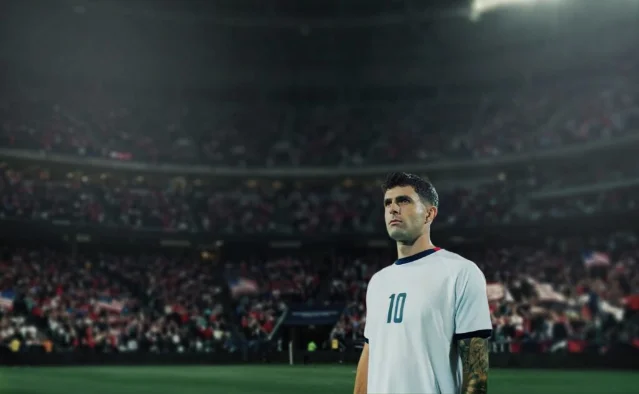
Brahma — "Tá Liberado Acreditar" (Africa Creative DDB, São Paulo)
Finally arriving with a full examination after being flagged twice in earlier issues, this Brazilian beer campaign is worth the wait. Africa Creative DDB built the film around a disarmingly honest data point: only 28% of Brazilians believe the Seleção can win a sixth World Cup in 2026. 2
The response to that statistic isn't denial — it's reframing. The campaign argues that Brazil's greatest victories always came when expectations were lowest, and it re-enacts iconic World Cup street moments to prove the point. Carlo Ancelotti, the current Brazil head coach, and Ronaldo appear not as invincibility symbols but as characters who know the pressure and choose to believe anyway.
The title, "Tá Liberado Acreditar" — roughly "You're allowed to believe" — reads differently in Portuguese than a translation captures. It has the tone of someone giving you permission after a long period of being made to feel naive. That's a culturally specific emotional note that only works because Africa Creative are drawing on genuine Brazilian football sentiment rather than generic tournament excitement.
コンテンツカードを読み込んでいます…
Powerade — "Power Your Fate" (WPP OpenX, New York)
The smallest-profile campaign in this issue, and the one that may age best. WPP OpenX built a 60-second film around Lamine Yamal and Rodrygo Goes — two players who, unlike Messi or Beckham, have their biggest moments ahead of them rather than behind them. 3
The spoken-word narrative connects elite training preparation to everyday players; the hydration message — never the most cinematic territory — is woven in rather than foregrounded. Powerade is the official sports drink of the 2026 tournament, so the sponsorship visibility is built-in; the creative task was to earn some attention on top of that visibility. The choice to cast two players who are still genuinely becoming rather than two who have already become is a smart long-term brand posture: if either Yamal or Rodrygo wins the Golden Boot this summer, this campaign immediately becomes one of the most-discussed of the tournament. If neither does, it's still a competent execution with strong casting instincts.
Levi's — The "Wrapped" Stadium (In-house)
No film. No celebrity. No media spend beyond what FIFA's own branding restrictions inadvertently created.
Levi's Stadium in Santa Clara, California, is one of the 2026 tournament's host venues. FIFA rules prohibit displaying commercial naming-rights branding during matches. Levi's was required to cover its stadium logo. Rather than draping a plain white sheet over the "batwing" silhouette, the brand's in-house team designed a wrap that uses the cover itself to reveal the logo's distinctive bat-wing shape — the name gone, the identity intact. 2
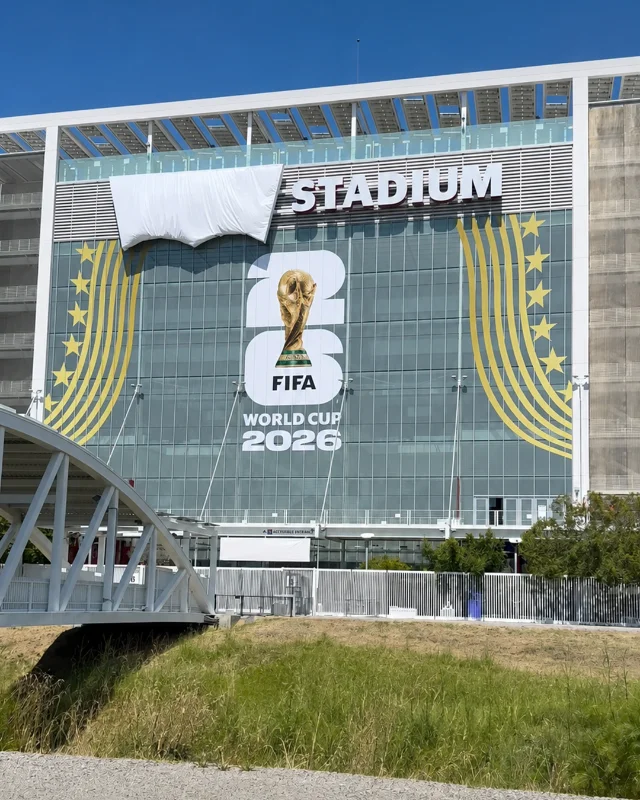
This is the kind of work that gets shared among creatives faster than any hero film. It costs almost nothing to execute once the idea exists. The brief practically writes itself: You have to cover the logo. How do you cover it so everyone still sees it?
Three observations from match week one
The Andrés Cantor question. Both Visa and Coors Light built campaigns around Andrés Cantor's goal call this summer — at the same tournament, running simultaneously. Cantor appeared in Visa's "Tap In" alongside Jason Sudeikis, and his son extended the Coors Light "Coooors Call" on social. Neither campaign suffers for it exactly, but the duplication illustrates a broader tournament dynamic: the set of genuinely iconic football voices and faces available for licensing is smaller than the number of brands that want them. Beckham is in five campaigns. Cantor is now in two sonic branding plays. At some point the scarcity value collapses. 2
National healing as the new creative territory. Buchanan's "Volvemos en Familia" is the most sophisticated example so far of a broader shift: brands finding emotionally specific national stories rather than generic "football unites the world" territory. Brahma's 28% pessimism flip and Budweiser's pairing of a retired, visibly emotional Klopp with a still-hungry Haaland both work on similar logic — acknowledging real, specific, human ambivalence rather than flattening everything into triumphalism. Expect more of this in the knockout stages when actual results make the stakes concrete.
Non-sponsors are winning the ambush arms race. Levi's stadium wrap, Coors Light's regulatory-gap sonic play, and Air Transat's pre-tournament price-comparison print work (Issue 1) are a collective argument that the most memorable executions of the 2026 cycle may not belong to official FIFA partners at all. The official partner roster — Adidas, Coca-Cola, Hyundai-Kia, Visa, Lenovo, Lay's, McDonald's, AB InBev — has the scale and stadium visibility. The non-sponsors are winning the creativity conversation. 3
参考ソース
- 1Buchanan's Volvemos en Familia — YouTube
- 2llllitl.fr — World Cup 2026: Watch The 26 Greatest Ads
- 3Budweiser Let It Pour — Brand Innovators FIFA World Cup Ad Tracker
- 4Gordon Ramsay Stars in Uber Eats World Cup Ad — DesignRush
- 5Uber Eats launches global campaign with Gordon Ramsay — Retail Tech Innovation Hub
- 6Visa launches Tap In campaign — Sports Business Journal
- 7Coors Light elongates name to celebrate World Cup goals — Marketing Dive
このコンテンツについて、さらに観点や背景を補足しましょう。