The Easter Bunny that killed Pluto

The Easter Bunny that killed Pluto

Meet Makemake — the dwarf planet whose discovery dismantled Pluto's status, and which JWST just revealed may hide a subsurface ocean and active volcanoes beneath its methane frost.

Wikipedia Featured Article
2026/6/15 · 8:10
2 订阅 · 28 内容
There is a world beyond Neptune that its discoverers nicknamed "Easterbunny." It has no rings, probably no substantial atmosphere, and until very recently appeared to be one of the more inert lumps in the outer solar system — bright, round, and boring. Then the James Webb Space Telescope pointed at it, and the story changed entirely.
Today, June 15, 2026, Wikipedia's editorial community has chosen Makemake (minor-planet number 136472) as the site's Featured Article of the day. The choice lands at a moment when the dwarf planet is genuinely newsworthy: 2024 and 2025 JWST observations have produced a string of surprises — gaseous methane, unusual isotopic chemistry, and hints of a warm interior that may harbor a subsurface ocean and active cryovolcanism. A body whose claim to fame was once "it helped get Pluto demoted" is turning out to have a geology of its own. 1
正在加载链接预览…

The discovery that broke the planetary club

On March 31, 2005, American astronomers Michael E. Brown, Chad Trujillo, and David Rabinowitz were scanning images from the 1.22-meter Samuel Oschin telescope at Palomar Observatory, California, as part of a systematic search for large trans-Neptunian objects they had been running since 2001. Brown noticed an object in the images on April 3 — it appeared exceptionally bright, which in the outer solar system means one of two things: very large, or very reflective, or both. 1
The team did not rush to announce it. They had a protocol. Then, in late July, a Spanish team at Sierra Nevada Observatory announced the discovery of what became Haumea — and it emerged that the Spanish team had accessed Brown's publicly exposed observing logs, raising an uncomfortable priority dispute. Brown's team contacted the Minor Planet Center on July 29, 2005 to announce both Makemake and Eris simultaneously, rather than risk being scooped again on two fronts. 1
The announcement of Eris — which appeared to be slightly larger than Pluto — forced the International Astronomical Union into a corner. If Eris was not a planet, Pluto probably wasn't either. The IAU met in Prague in August 2006 and for the first time formally defined what a planet is. Pluto, Eris, and Makemake all failed the third criterion (clearing the neighborhood of their orbits) and were reclassified as dwarf planets. Makemake was the fourth body to receive that designation, after Ceres, Pluto, and Eris, and the first to be named under the new IAU procedures specifically designed for expected dwarf planets. 1
The name took three years. Brown struggled to find mythology that fit. The discovery had happened just after Easter, so the team called it "Easterbunny" internally. Brown considered the Anglo-Saxon spring goddess Ēostre and the Anishinaabe trickster rabbit Manabozho, but both options had complications. In July 2008, the IAU approved "Makemake" — the creator of humanity and god of fertility in the mythology of the Rapa Nui people of Easter Island. The Easter connection held; the name satisfied the IAU rule that classical Kuiper belt objects be named after creator deities. 1 The symbol added to Unicode in January 2022 — ⟨🝼⟩, U+1F77C — was designed by Denis Moskowitz and John T. Whelan and represents a traditional Rapa Nui petroglyph of Makemake's face, stylized as an "M." 1

A 307-year journey, tilted and eccentric

Makemake belongs to the classical Kuiper belt — the broad disk of icy bodies orbiting the Sun at 30–50 AU (one AU is the Earth-Sun distance). Its orbit takes 306.70 years to complete, at an average distance of 45.5 AU (about 6.81 billion km). Right now, in mid-2026, it is near aphelion — its farthest point from the Sun — at 52.7 AU, and will reach aphelion in May 2033 before beginning a centuries-long fall back toward perihelion in November 2186. 1
What distinguishes Makemake's orbit from many Kuiper belt objects is its inclination: 29° with respect to the ecliptic (the plane of Earth's orbit). Most planets orbit within a few degrees of that plane. Makemake is significantly tilted — a sign, according to the Nice model of solar system formation, that it originally accreted closer to the Sun and was gravitationally scattered outward by Neptune's migration around 4 billion years ago. The orbit is stable on billion-year timescales according to N-body simulations. Makemake is also classified as a plutoid — the subclass of dwarf planets that orbit beyond Neptune. 1
正在加载链接预览…

A bright, nearly round world

At roughly 1,430 km in diameter (about 60% the width of Pluto, and a bit smaller than Pluto's moon Charon), Makemake is the fourth-largest known trans-Neptunian object. Its shape is nearly spherical — measurements give dimensions of 1,434 × 1,420 km, with a flattening consistent with a body in hydrostatic equilibrium rotating at its current rate. Mass has been determined at (2.69 ± 0.20) × 10²¹ kg, using the orbital period and distance of its moon; bulk density works out to about 1.76 g/cm³, which implies an interior dominated by rock and water ice, probably differentiated into a rocky core surrounded by ice layers. 1
The most striking physical fact is how reflective it is. Makemake's geometric albedo is 0.82 — 82%, more reflective than Pluto. That makes it the second-brightest trans-Neptunian object in Earth's sky by apparent magnitude, after Pluto (Eris is intrinsically brighter but farther away, so dimmer to us). Peak brightness at opposition, in March or April, reaches around apparent magnitude 17 — visible to amateur astronomers with a 16-inch or larger aperture telescope. 1
The brightness also tells a story. A surface that reflects 82% of incoming light is either freshly surfaced or continuously renewed. On Makemake, the answer involves methane.

Pure methane, and almost nothing else

JWST spectroscopy in 2024–2025 gave planetary scientists the clearest picture yet of Makemake's surface chemistry. The results were somewhat unexpected — not because methane ice was found (Brown's team suspected it from the beginning), but because of what was absent. 1
Pluto's surface is a mixture of methane, nitrogen, and carbon monoxide ices. Eris has a similar blend. Makemake has essentially no nitrogen and no carbon monoxide. JWST measured less than 3% nitrogen and less than one part per million of CO. Without those two common volatiles to mix into, Makemake's methane sits pure on the surface — growing into unusually large, centimeter-scale grains and accumulating to considerable thickness. The freshly deposited methane explains the high albedo: bright new ice periodically covers up the darker, reddish material underneath. 1
That darker material is tholins — complex hydrocarbons formed when ultraviolet light and cosmic rays bombard methane over millions of years. The photochemistry cascade runs: methane → ethane → ethylene → acetylene → progressively complex tholins. JWST confirmed the presence of ethane, ethylene, and acetylene in addition to methane on Makemake's surface. The result is a world that is less red than Pluto but redder than Eris — a pale reddish-brown, like dried clay. 1
The absence of nitrogen has a practical explanation. Nitrogen vapor escapes more easily from a lower-gravity body; Makemake, being smaller than both Pluto and Eris, probably lost most of its nitrogen to space long ago. The missing carbon monoxide is less understood — it may reflect how Makemake formed, or how hydrothermal chemistry inside it processed CO into something else. William Grundy, Alex Parker, and colleagues have suggested that the abundant pure methane may produce a surface geography similar to Pluto's: possible bladed terrain, convecting methane glaciers, and perhaps a longitudinal dark band analogous to Pluto's Belton Regio — though no probe has yet visited to confirm any of it. 1
正在加载链接预览…

What JWST found in the gas and the guts

Beyond the surface, JWST delivered two deeper surprises.
The first was gaseous methane. JWST detected methane fluorescing in the near-infrared — a signature of gas, not solid ice. Makemake becomes only the second trans-Neptunian object confirmed to have gas, after Pluto. Whether this gas constitutes a gravitationally bound atmosphere or is simply temporary outgassing from sublimation or volcanic venting remains unresolved. If it is a true atmosphere, the surface pressure is roughly 10 picobars — 100 billion times less than Earth's, and roughly one million times thinner than Pluto's thin atmosphere. That would explain why a 2011 stellar occultation (the only one ever recorded for Makemake) detected no atmosphere at all: at such a pressure, the signature would have fallen below the measurement threshold. 1
If it is outgassing rather than a bound atmosphere, the mass loss rate works out to roughly 266 kg of methane per second escaping from 4–30% of the surface. That rate is comparable to the water plumes erupting from Enceladus, the small icy moon of Saturn whose geysers are among the most dramatic geological features in the solar system.
The second surprise involves isotopes. JWST detected deuterated methane (CH₃D) on Makemake — methane in which one hydrogen atom has been replaced by deuterium, a heavier hydrogen isotope. The measured deuterium-to-hydrogen ratio is (2.9 ± 0.6) × 10⁻⁴ — significantly lower than the D/H ratio found in cometary methane, but similar to the D/H ratio in cometary water. 1
That similarity matters. In hydrothermal systems — chemical reactions between hot rock and liquid water — deuterium tends to migrate from water into other molecules. A 2024 study by Christopher Glein and colleagues argues that Makemake's deuterium-poor methane may have inherited its hydrogen from geochemical reactions in subsurface liquid water at temperatures around 150°C, implying a warm, geologically active interior. A competing interpretation holds that the methane is primordial — captured directly from the protosolar nebula during accretion — and requires no current interior heat. Both explanations fit the current data. 1
A 2025 study by Csaba Kiss and colleagues adds another piece. Makemake has shown excess mid-infrared emission — slightly more heat than expected from a passive, sun-warmed surface — since it was first measured by the Spitzer Space Telescope in 2008. Kiss et al. propose two explanations: either a cryovolcanic hotspot covering roughly 350 km² at around 150 K (−123°C), or a ring of tiny carbonaceous dust grains in orbit. They favor the cryovolcanic scenario because a dust ring would be destroyed by solar radiation pressure within a decade unless continuously resupplied — which would itself require an active geological process. If the hotspot interpretation is correct, Makemake may be venting heat comparable to Enceladus's south pole, possibly erupting cryolava of ammonia and salts dissolved in liquid water. 1
None of this is confirmed. But the evidence, from three independent lines — isotopic chemistry, excess thermal emission, and outgassing rates — is pointing in the same direction.

The unnamed moon

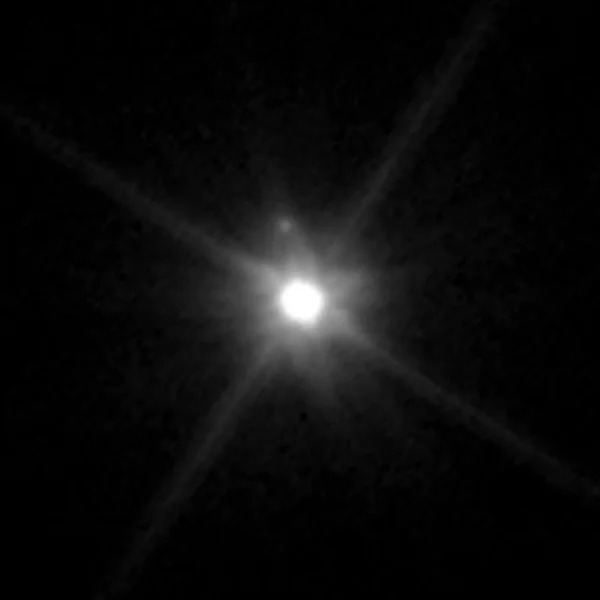
In April 2015, astronomers Alex Parker, Marc Buie, William Grundy, and Keith Noll used the Hubble Space Telescope to find something orbiting Makemake. The moon, provisionally designated S/2015 (136472) 1 and unofficially nicknamed "MK 2," is about 175 km across — a pinprick compared to Makemake, and roughly 1,300 times fainter in visible light. Its surface appears extremely dark, in stark contrast to Makemake's bright methane ice. 1
The moon's orbit is nearly circular, with a semi-major axis of about 22,250 km and a period of 18 days. At the time of discovery, the orbit appeared nearly edge-on from Earth — the moon passed in front of and behind Makemake in the Hubble images. No additional moons brighter than apparent magnitude 26.9 have been found beyond 30,000 km from Makemake, though smaller or closer objects could exist. The moon has no official name; the IAU naming process for Makemake's satellites has not yet produced a formal designation. 1
The moon's dark surface is not just a curiosity. It helps account for some of the discrepancy between Makemake's overall brightness and the thermal emission figures — a very dark satellite absorbs more heat and emits more infrared than a bright one, and at certain orbital orientations it would pull the measured average in ways that affect interpretations of the main body.

The long wait for a closer look

No spacecraft has visited Makemake. Through any Earth-based telescope it appears as a star-like point of light; even the largest ground-based instruments cannot resolve surface features. The sole close approach on record is from the New Horizons spacecraft — the probe that flew past Pluto in 2015 — which observed Makemake from roughly 0.1 AU in 2024, its closest point. New Horizons can track Makemake's motion against background stars but cannot image its surface at that distance. 1
Earliest recorded observations of Makemake date to January 29, 1955 — precovery images found in archival plates that extend the known observation arc to over 70 years. A 2004 image from the Sloan Digital Sky Survey shows it as a faint dot passing in front of galaxy NGC 4274. Those archival data helped pin down its orbit; they reveal nothing about what is happening on the surface or underground.
Concept missions have been studied — direct flyby trajectories with travel times of 9.6 to 23.6 years, or faster routes using a Jupiter gravity assist — but none has been approved for development. The case for a dedicated probe is stronger now than it was a year ago: an active interior, possible cryovolcanism, and a candidate subsurface ocean make Makemake a more compelling target than a simple ball of ice. 1
An "Easterbunny" that turned out to carry an ocean underneath its methane frost was not what anyone was expecting in 2005. The outer solar system keeps returning this verdict: the boring-looking objects aren't.
Cover image: Makemake and its moon S/2015 (136472) 1, Hubble Space Telescope, April 2015, via Wikimedia Commons

围绕这条内容继续补充观点或上下文。

  • 登录后可发表评论。